UMG Insight Documentation
Installation, Widget Blueprint analysis workflow, generated outputs, review boundaries, and AI-assisted UI modification context.
UMG Insight
Unreal Editor analysis plugin for Widget Blueprint structure review, UI interaction visibility, and modification-focused UMG review context.
Unreal Engine 5.4 - 5.7
Designed for Windows editor workflows and Win64 plugin distribution unless otherwise stated on the product listing.
Understand UI structure before modifying it.
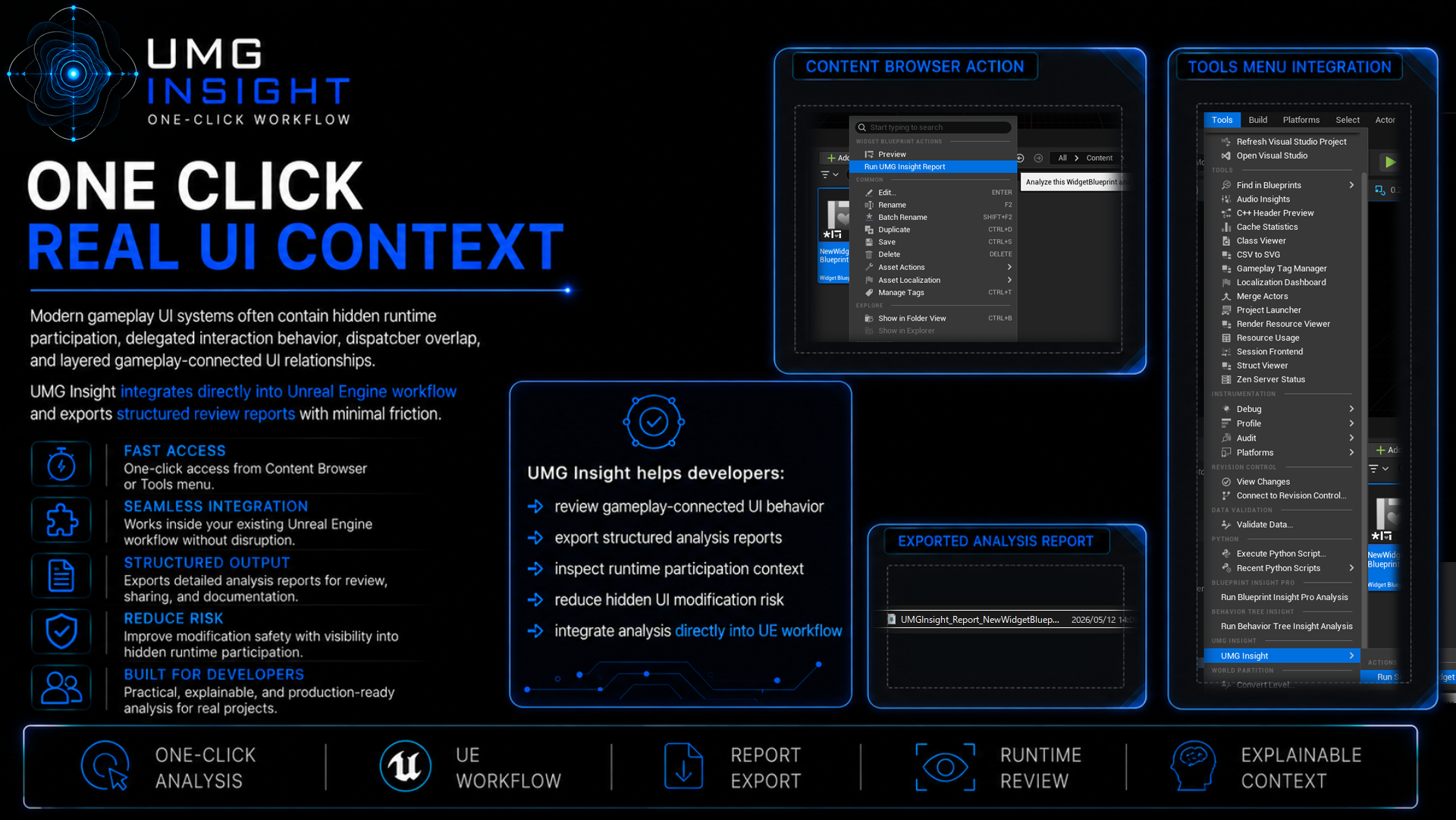
UMG Insight helps developers review Widget Blueprint hierarchy, bindings, dispatcher evidence, visibility-related structure, and interaction routing context before making UI changes.
Review visibility and interaction context, not automatic UI creation.
UMG Insight does not generate UIs, rewrite Widget Blueprints, or claim runtime correctness. It produces review material to help humans and AI assistants understand UI behavior structure before modification.
Recommended First Steps
- Select or open the Widget Blueprint you want to review.
- Run UMG Insight from the Content Browser action or Tools workflow.
- Open the generated Markdown reports in Saved/UMGInsight.
- Use the reports when planning UI modifications or AI-assisted edits.
Install the Plugin
- Close Unreal Editor.
- Copy the plugin folder into your project's
Pluginsfolder. - Confirm the plugin folder is directly under
<YourProject>/Plugins/. - Reopen the project in Unreal Editor.
- If Unreal asks to rebuild modules, allow the rebuild.
Enable the Plugin
- Open
Edit > Plugins. - Search for
UMG Insight. - Enable the plugin if it is not already enabled.
- Restart the editor if Unreal asks you to do so.
Run UMG Insight Analysis
- Open your Unreal Engine project.
- Select a Widget Blueprint in the Content Browser, or open the Widget Blueprint you want to review.
- Run UMG Insight from the available Content Browser action or Tools > UMG Insight workflow.
- Wait for report generation to complete.
- Open the generated reports under <YourProject>/Saved/UMGInsight/.
UMG Insight is intended for static Widget Blueprint review before modification. It does not generate UI or automatically change Widget assets.
Generated reports are intended to be inspected by developers and may also be shared with AI assistants for technical discussion.
Report Files
UMG Review Output
<YourProject>/Saved/UMGInsight/
Widget Blueprint structure review reportinteraction routing review summaryvisibility and state coordination notesdelegation-aware review notesmodification review context reportAI-readable Markdown review material
What It Helps Review
- Widget Blueprint hierarchy summary
- Named widget and component structure
- Binding and dispatcher evidence
- Interaction-routing evidence
- Visibility-related review context
- Delegated behavior flow candidates
- Interaction locality hints
- Modification review context
- AI-readable UI structure reports
Review Boundaries
- UMG Insight performs static editor-side analysis.
- It does not generate UI, rewrite Widget Blueprints, or automatically approve safe modifications.
- It does not simulate exact runtime behavior or guarantee runtime execution order.
- It does not replace manual UI testing or gameplay validation.
- Reports are intended to help humans and AI assistants review UI behavior with better context before modification.
Static reports should be treated as evidence-based review material. Runtime behavior, branch conditions, dynamic data, and project-specific design intent may require manual verification inside Unreal Editor.
Do NOT Give AI Only The Full Project Export
When using Insight Ecosystem outputs with AI-assisted workflows, we strongly recommend providing both the full project export and a focused Runtime Package for the specific system currently being modified.
providing BOTH:
- the full project export
- a focused Runtime Package
This is extremely important for long Unreal Engine implementation sessions.
Why?
During large Blueprint-driven workflows, AI may gradually drift from:
system-level runtime reasoningtoward:
localized patch reasoningespecially during manual Blueprint wiring, runtime suppression work, BT/EQS modifications, montage-related implementation, and dispatcher-heavy systems.
The problem is often not lack of information. The problem is:
loss of topology focusRecommended Workflow
1. Full Insight Export
This provides overall project structure, global topology, and cross-system visibility.
2. Focused Runtime Package
This stabilizes runtime ownership awareness, convergence tracking, orchestration understanding, and cleanup path awareness for the system currently being modified.
Example
For a melee combat modification, a Combat Runtime Package might include:
- related BTTasks
- related BTServices
- related Blackboard assets
- combat orchestration Blueprints
- related AnimBP sections
- related dispatcher / notify data
- related hidden_dependencies excerpts
- related comment_clusters excerpts
while excluding unrelated systems such as UI, unrelated locomotion, unrelated player systems, and unrelated vehicle systems.
Important
This is not primarily about reducing file size. It is about:
stabilizing the AI's runtime attention topologyIn practice, this can significantly reduce local patch drift, screenshot anchoring, orchestration confusion, cleanup-path mistakes, and runtime ownership loss during long AI-assisted Unreal Engine sessions.
For more detailed discussion about AI reasoning drift, synchronization rules, structure-first workflows, and runtime orchestration safety, please see:
Return to the product page or Insight Ecosystem.
Use this direct documentation page for Fab documentation links, product review, and AI-assisted workflow reference.